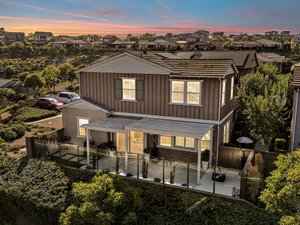
You bought on the coast before people fully understood what coast meant in terms of long-term value.
Maybe it was Niguel Shores in the early 1990s. Maybe the Lantern District before it became what it is today. Maybe Dana Hills, when the neighborhood was quiet and the price felt reasonable for what you were getting — which was proximity to the water, the harbor, and a quality of life that was genuinely different from the rest of South OC.
That home is worth a lot more than you paid for it.
Depending on the neighborhood and when you bought, you may be sitting on $1 million to $2 million or more in appreciation. You know the number exists. What most longtime Dana Point homeowners haven't fully worked through is what that number actually means — and what planning around it looks like before a decision gets made.
The Numbers Are Bigger Here. So Is the Planning Gap.
Dana Point is not a uniform market. Monarch Beach and Niguel Shores carry different price profiles than Dana Hills or Capistrano Beach. But across the city, homes purchased in the late 1980s through the 1990s have appreciated significantly — in many cases well past the point where a standard sale generates meaningful taxable gains.
Take a home purchased in Niguel Shores in 1991 for $350,000, now worth $3 million. That's $2.65 million in total appreciation. After the $500,000 married exclusion, $2,015,000 is potentially taxable. At combined federal and California capital gains rates, the exposure on that amount can reach $685,100 to $765,700 or more.
That's real money. And it's money most families don't know is sitting inside the transaction until they're already in escrow — which is too late to do much about it.
The answer isn't necessarily to delay the sale. For many Dana Point homeowners, moving still makes complete sense after accounting for the tax picture. But understanding the exposure before you commit to anything changes what options are available.
This is a real estate planning conversation, not tax or legal advice. Always coordinate with your CPA and estate attorney.
What Prop 19 Means for a Dana Point Homeowner
If you've been in your Dana Point home since the early 1990s, your property tax base is locked in at a fraction of current market value.
A Niguel Shores home assessed at a 1991 purchase price — even with 30-plus years of small annual increases — generates a tax bill somewhere around $4,500 to $6,000 a year. That same home assessed at today's value could carry a bill of $18,000 to $20,000 annually.
The gap is $12,000 to $14,000 a year. Over a decade, that's well over $100,000.
Under Prop 19, California homeowners who are 55 or older can transfer their existing property tax base to a replacement primary residence anywhere in California — up to three times. If the new home is less expensive than what you sold, you carry the full base. If it costs more, the difference gets factored in, but you still preserve a meaningful portion of the savings.
For Dana Point homeowners who've been watching the coast appreciate and assuming they'd never be able to replicate their tax situation if they moved — this changes the picture considerably. The question is whether that conversation has actually happened, with the right numbers, before any decisions get made.
Coastal Equity Is Concentrated. That Concentration Has Consequences.
Dana Point homeowners have something most inland South OC homeowners don't: concentrated coastal appreciation in a market where inventory stays genuinely limited.
That's an asset. But it's an illiquid one.
The equity in a Monarch Beach or Lantern District home isn't paying for anything while it sits in the walls. It's not generating income, funding retirement, or providing flexibility. For longtime homeowners whose largest financial asset by far is their home, that concentration creates a planning question worth taking seriously: what would your financial life look like if some of that equity were accessible?
This isn't a sales pitch to move. Some families are exactly right where they are. But "we haven't thought through it yet" is different from "we've looked at the numbers and staying is the right call." Most families haven't actually done the second thing.
The Step-Up in Basis. The Decision That Often Goes Unexamined.
If a longtime Dana Point homeowner passes away and their children inherit the property, the cost basis resets to fair market value at the date of death. The step-up in basis.
For a home purchased in 1991 for $350,000 and worth $1.6 million at death, the heirs inherit it with a $1.6 million basis. If they sell within a year or two, the taxable gain is near zero. The $1.25 million in lifetime appreciation disappears from the tax calculation entirely.
If that same family had sold while the parent was still living, that $750,000 in taxable gains — above the exclusion — would have been on the table.
This is a six-figure planning decision that most families stumble into rather than making deliberately. The answer isn't always to hold until death. For homeowners who want to access their equity now, while they're healthy and able to enjoy it, that may be the right call even with some tax exposure. But the decision should be made with clear eyes — not discovered after the fact.
The Conversation Most Dana Point Families Haven't Had Yet
The estate attorney set up the trust. The CPA files the returns. But the real estate planning conversation — the one that ties the equity to the tax situation, the family's actual goals, and what comes next — often doesn't happen until something forces it.
If you've been in your Lantern District, Niguel Shores, Monarch Beach, or Dana Hills home for 20 or 30 years and you want to understand what your equity actually means — not just the estimate, but the real picture — that's exactly the conversation I do.