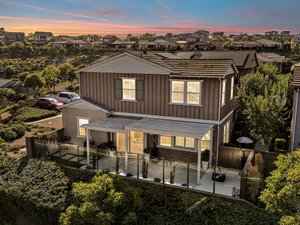
You bought in Glenwood back when Aliso Viejo was still being built out.
Or Pacific Ridge, when the HOA was brand new and the neighbors were all around the same age.
You were probably in your 30s. Maybe younger. The neighborhood felt fresh. The schools were excellent. And the price — somewhere in the low $300s if you got in early — felt like a stretch at the time.
That same home is worth somewhere between $1.4 million and $1.7 million today.
You know the number, roughly. But most longtime Aliso Viejo homeowners haven't worked through what that number actually means — what it enables, what it costs to ignore, and what a sale would look like on the tax side.
The Equity Is Real. But It's Not Simple.
Here's what's inside a typical Aliso Viejo home bought in the mid-to-late 1990s:
A purchase price somewhere around $280,000 to $320,000. A current market value somewhere around $1.4 million. Total appreciation: $1,080,000 or more.
Most people focus on the top-line number. And it's real.
But the planning question isn't how much the home is worth. It's what happens to that money when you decide to access it — and how that answer shifts depending on when you sell, how you sell, and what your CPA says before you do.
The Capital Gains Picture Aliso Viejo Families Often Miss
The IRS allows married couples a $500,000 exclusion on gains from the sale of a primary residence. Most people know this in a general way.
What longtime Aliso Viejo homeowners often haven't worked through is the exposure above that number.
Take a home purchased in 1997 for $300,000, now worth $1.1 million. That's $800,000 in total gains. After the $500,000 married exclusion, $300,000 is potentially taxable. At combined federal and California rates, that can translate to a tax bill in the range of $75,000 to $120,000 or more depending on income and filing status.
That's not a reason not to sell. For many families the move still makes complete financial sense. But it's a reason to know the number before you're already in contract — and to have your CPA in the room before a listing agreement gets signed.
The expensive mistakes don't usually come from bad decisions. They come from decisions made without the full picture.
This is a real estate planning conversation, not tax or legal advice. Always coordinate with your CPA and estate attorney.
Prop 13 Has Been Working for You. Prop 19 Can Keep That Going.
Aliso Viejo was incorporated in 2001, but homes there were being built and sold through the 1990s. If you bought early, your property tax base has been locked in for 25 to 30 years.
A home assessed at its 1997 purchase price of $300,000 — even accounting for the small annual Prop 13 increases — generates a tax bill around $3,600 to $4,000 a year. The same home assessed at current market value would carry a bill closer to $13,000 to $15,000 annually.
That's a gap of $9,000 to $11,000 a year. And you've been keeping it.
Under Prop 19, California homeowners who are 55 or older can transfer that existing property tax base to a replacement primary residence anywhere in the state — up to three times. If the new home costs more than what you sold, the difference gets factored in. But you still carry a significant portion of the benefit.
For Aliso Viejo homeowners who assume moving means their tax bill will triple, this changes the math considerably. The question isn't whether to move. It's whether you've actually run the real numbers with Prop 19 included.
The mechanics, the timing, and the filing requirements are specific enough that this needs to be part of the planning conversation — not an afterthought once you're already in escrow.
The Equity Sitting in Your Home Isn't Working for You
Aliso Viejo was never a flashy address. It was a practical, well-planned community with good schools, well-run HOAs, and a clean suburban quality of life that worked extremely well for families raising kids.
A lot of those families are still there. The kids are grown. The school district isn't the driver anymore. And the equity that's accumulated over 25 or 30 years is sitting in a house that may be larger and more maintenance-heavy than the life that's actually being lived in it.
Home equity doesn't compound. It doesn't fund a trip to see your grandkids. It doesn't help your son with a down payment or reduce the financial pressure of a fixed income.
For a lot of longtime Aliso Viejo homeowners, the equity in their home is the largest single financial asset they own. And it's sitting there, waiting, while the carrying costs of the home continue every month.
That's not automatically wrong. There are real reasons to stay. But the question worth asking honestly is: if that equity were liquid, what would your life look like? What would it make possible?
Most families haven't actually worked through that answer.
What Happens to the Equity After You're Gone
This is the conversation nobody wants to start. But for families with a trust — and most longtime South OC homeowners should have one — it's one of the most consequential pieces of the financial picture.
If your children inherit your Aliso Viejo home after you pass, the cost basis resets to fair market value at the date of your death. This is the step-up in basis. If they sell shortly after inheriting, the taxable gain is near zero — regardless of how much appreciation happened over 30 years of ownership.
The $800,000 in appreciation that would generate a significant tax bill if you sold today? Largely gone from a tax perspective if the home transfers at death.
This creates a real tension that families rarely think through explicitly: sell now and access the equity while you're alive and healthy, accepting some tax exposure? Or hold, pass the home through the trust, and preserve that step-up in basis for your heirs?
There's no universal answer. It depends on your health, your financial needs, your kids' situations, what your CPA recommends, and what the trust documents actually say.
But families who never have this conversation are making a six-figure decision by default. And default is rarely the best plan.
The Conversation Most Aliso Viejo Families Put Off
The estate attorney set up the trust. The CPA files the returns. But the conversation that connects the equity to the tax picture, the family dynamics, the timing, and the next chapter — that one often doesn't happen until something forces it.
If you've been in your Glenwood, Pacific Ridge, or Aliso Viejo Country Club area home for 20 or 30 years and you want to understand what your equity actually means — not just the Zillow number, but the real picture — that's the conversation I do.