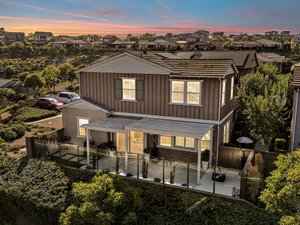
Your parents bought the house before you were in high school.
Maybe before you were born.
They've repainted it four times. They know every neighbor. There's a rose bush in the backyard your mom planted 22 years ago and has never once stopped talking about.
And now — for whatever reason — the conversation has started.
Maybe your dad's knees aren't great on the stairs anymore. Maybe your mom mentioned the yard feels like too much. Maybe it came up at a holiday dinner and nobody quite knew what to say, so everyone changed the subject.
That's usually how it starts.
This Isn't a Normal Real Estate Transaction
I want to say that clearly, because families who treat it like one tend to hit walls they weren't expecting.
Selling a home after 30 years is part financial decision, part logistical project, and part grief.
All three are happening at the same time. And if you only plan for the financial and logistical parts, the emotional piece will slow everything down — and cause real friction between family members who actually agree on the goal.
The Financial Picture Is More Complex Than Most Families Realize
A longtime homeowner in South OC isn't just sitting on a house.
They're sitting on 30 years of appreciation, a property tax base locked in at a fraction of current market value, and often a cost basis that is nowhere near what the home is worth today.
A few things worth understanding before you do anything:
Capital gains exposure. The IRS allows a $500,000 gain exclusion for married couples selling a primary residence. That sounds like a lot. In Laguna Niguel, Dana Point, or Aliso Viejo — where longtime homeowners routinely have $800,000 to $1.5 million in appreciation — it may not be enough. What's left over is taxable, if you don’t protect it with a plan. Your parents' CPA needs to be part of this conversation before you list.
Prop 19. Since February 2021, California allows parents to transfer their property tax base to a replacement home anywhere in the state, one time. The replacement home needs to be of equal or lesser value to keep the full benefit. There are rules, deadlines, and forms — and missing them is permanent. This is a real estate planning conversation worth having early, not after you're already in escrow.
Property tax reset. If your parents are moving to a smaller place, their monthly costs could change significantly. A $600,000 condo assessed at current rates carries a very different tax bill than a $1.4 million house assessed at 1990s values. Understanding that math before they commit to a purchase matters.
This is a real estate planning conversation, not tax or legal advice. Always coordinate with your CPA and estate attorney.
The Emotional Part Nobody Plans For
I've sat in a lot of living rooms with families navigating this.
The most common thing I see isn't conflict about money. It's that the parent isn't actually ready — and sometimes doesn't know it yet — and the adult children are moving at a pace that feels to the parent like being pushed out of their own story.
The house isn't just a house. It's where your kids learned to ride a bike in the driveway. It's where you hosted 30 Thanksgivings. It's the last place everything felt normal before the world changed.
Moving from it isn't a transaction. It's a transition. And transitions take longer than timelines.
What actually helps:
Start before you have to. The families who plan 12 to 18 months ahead move with less chaos than the ones who start because something forced the conversation. When there's no urgency, there's room to have the real conversations — about timing, about what the next place looks like, about what staying actually costs.
Lead with where they're going, not what they're leaving. Research on senior relocation is consistent on this: people who are moving toward something — a smaller home closer to grandkids, a place where they're not managing a yard alone — do measurably better than people who are fleeing a situation that got untenable. Reframing the conversation from "we need to get you out of that house" to "let's figure out what the next chapter actually looks like" changes the whole dynamic.
Give everyone a seat at the table, but be clear whose decision it is. Adult children have opinions. Sometimes very strong ones, and sometimes based on incomplete information. One of the most useful things I do in a family real estate planning conversation is put the real numbers on the table — what the home is worth, what the options cost, what the timing looks like — so everyone is working from the same facts. It doesn't eliminate disagreement, but it changes the arguments.
The Stuff. (Yes, We Have to Talk About It.)
Nobody wants to say it, but it is always part of the conversation.
Forty-seven coffee mugs. Every holiday card since 1986. Four sets of dishes. The furniture that belonged to a grandparent, and nobody knows whose it is now, but everyone has a feeling about it.
A 30-year home is a life. And sorting through it is one of the hardest parts.
The mistake families make is waiting until the house is listed to deal with it. What actually works is treating it as its own separate project, started well before you're thinking about open houses. Break it into tracks: what goes to the new home, what gets gifted to family now, what gets sold through an estate sale company, what gets donated, what's junk. Give it breathing room.
A professional organizer or a move manager who works with longtime homeowners can be worth every dollar. This is not the project to try to sprint through in two weekends.
What "Planning Early" Actually Looks Like
It doesn't mean listing the house before anyone is ready.
It means sitting down — ideally with an agent who understands this kind of transition, a CPA who can map out the tax implications, and an estate attorney if there's a trust involved — and getting clear on the real picture before any decisions are made.
What's the home worth right now?
What would the net proceeds actually be after taxes and costs?
What are the realistic options for where your parents could go — and what would those cost?
What happens to the property tax base, and how does the timing of a sale affect it?
What needs to happen with the trust before the property can be transferred?
These questions don't take long to answer. But most families don't ask them until they're already in motion — and by then, some of the best options are off the table.
One More Thing
My parents lived in their home in Irvine for 30+ years. When they finally moved to Laguna Niguel — closer to me in Aliso Viejo, closer to my sister in Dana Point — the trigger wasn't the house being too big.
It was that the house felt too empty.
The kids were gone. The neighborhood had changed. And being close to the grandkids, to family, to people who showed up — that was worth more than the square footage they were leaving.
They'll tell you now it was the right move. Not because of what they gave up. Because of what they moved toward.
That's the conversation worth having.